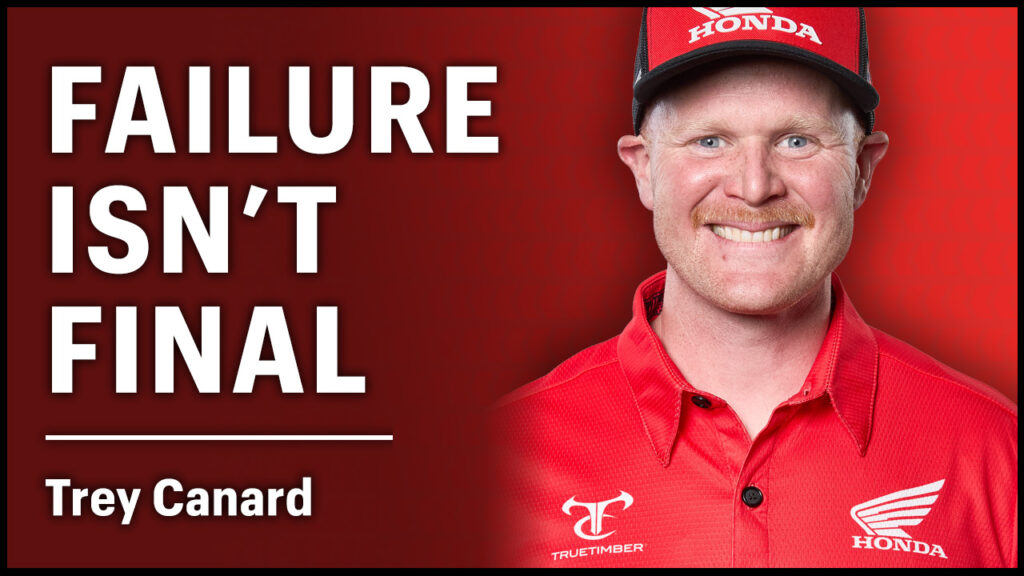
Trey Canard is showing up at the races with a different job description than the one most of us grew up watching. He’s working with HRC and the Lawrence brothers, thinking about bike setup, mindset, and how to help other riders become better athletes. From the outside, it can look like a smooth evolution from racer to mentor, but the path that got him here was anything but straightforward.
Listening to him, you hear a rider who spent years measuring himself by outcomes, results, championships, how quickly he could come back from injury, and is now very aware of how limiting that mindset was. Effort over outcome is a phrase that came up more than once, and it’s a useful way to understand his story.
Full Episode Links:
When everything is outcome
Trey’s career has plenty of obvious “failure isn’t final” moments: big crashes, spinal cord trauma, seasons wiped out, and then an early decision to stop racing at the top level. None of those felt good or meaningful in the moment. They felt like the end of something he had been building since he was five years old.
For a long stretch, injury recovery was just a race to get back to riding. The only acceptable outcome was lining up again. Weekends carried the same weight. If the result sheet didn’t match the work he’d put in, it felt like the work didn’t count.
That’s a pretty normal way to think in motocross. We’re surrounded by language like “you’re only as good as your last race”, and it’s easy to let a bad night, a bad season, or a contract year define you. In that environment, outcome quietly becomes the main measure that matters.
Shifting to effort over outcome
What’s different now is how clearly Trey can see the pattern. Looking back, he notices that the races where he performed best weren’t the ones where he was obsessed with winning. They were the ones where he focused on the quality of his riding and the effort he could actually control.
The bigger injuries forced that shift. When you’re dealing with spinal cord issues or staring down another long rehab, you don’t get to control the timeline in the same way. You can’t white knuckle the bone or nerve to heal faster. What you can do is keep showing up for the things right in front of you: the rehab work, the appointments, the daily choices that give you the best chance to move forward.
Effort over outcome doesn’t mean results don’t matter. It means the metric you live by is the work you put in, not a number on the board that lives outside your control. Over time, that’s what allowed Trey to see that a bad race, a rough season, or even the end of his pro career didn’t have to be a full stop.
Failure isn’t final, especially with support
Trey pushed back on the idea that failure is permanent. He pointed to Hunter Lawrence as one example: heavy shoulder and knee injuries, years where people were quietly wondering if it was going to work out, and now he’s leading the 450 championship. In the middle of those injury years, it would have been easy to say “this is it”. With a few more seasons behind him, the same story reads very differently. The “finished” part turned out to be a chapter, not the whole book.
Support is a big part of that. Trey was honest that you can’t just be “tougher” forever and expect that to fix everything. Having people around you who care about you as a human, family, friends, people on the team, changes how you interpret failure and what you do next with it. Without that, it’s easy for an injury or a bad season to turn into a story about your worth instead of feedback about your situation.
When he talks about the Lawrence family, you can hear how much he values their unit and their willingness to keep learning together. They’re not immune to failure. They just treat it as information, not a label.
Jett’s injury and matching effort in the healing
One moment that stood out in this episode was Trey describing Jett Lawrence’s recent injury and rehab. What impressed him was that Jett treats healing as part of the job and puts as much intention into the process as he normally puts into racing.
For most riders, being hurt feels like a pause. You sit, you wait, you do the basics you’re told to do, and you count down until you can ride again. Trey noticed that Jett treats the healing work as something he’s responsible for, not just something happening to him. The same effort that usually goes into motos and sprints goes into physical therapy, rest, and respecting the plan.
That’s effort over outcome in a very practical sense. You don’t decide exactly how fast your body repairs itself. You do decide whether you will treat the healing work with the same seriousness as your on the bike training.
What this means for the rest of us
Most of us won’t live Trey’s exact story. Our “failures” might look like a rough local series, time off the bike, or goals we keep missing. The pattern he describes still applies.
A few simple takeaways:
- Results are information, not identity.
- Effort, the part you control, is a healthier anchor than outcome.
- Failure, whether it’s a DNF, an injury or a life decision like retirement, doesn’t have to be final if you’re willing to learn from it and you’re not doing it alone.
If you’re in the middle of something that feels heavy, injury, burnout, or just a season that won’t turn around, this conversation with Trey (and the way he talks about riders like Jett and Hunter) is a reminder that your story isn’t finished. The next good chapter usually starts with where you put your effort today, not with what the last result sheet said.
Support BikeGraphix
BikeGraphix: Fully Custom Bike Graphics, 15% off w/ code seat15.
0 Comments
Leave A Comment