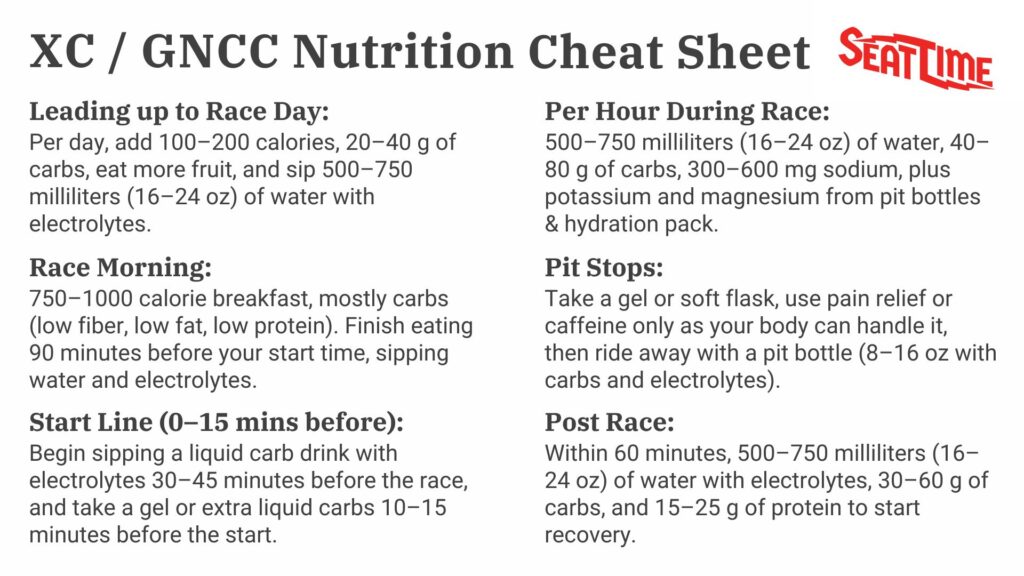
Whether you race local hare scrambles for 90 minutes or line up for the Grand National Cross Country (GNCC) 3‑hour program, you have to fuel your body for the length of the race you’re competing in. The length of the race and the level of intensity are the primary factors in how you evolve your nutrition strategy. In this article, we’ll cover the basics of race‑day nutrition and hydration so you have a solid foundation to build from, and then we’ll dig into specifics for riders who want to fine-tune their fueling strategy.
What is race nutrition and hydration?
Race nutrition and hydration is the water, food, and electrolytes you take in leading up to a race weekend, on race morning, during the race, and after the race. How you fuel your body for a race starts days before you gear up and ride to the starting line. If you have a race the following day or weekend, the way you fuel afterward also matters for recovering from what you’ve put your bike, body, and mind through.
What we’re going to discuss in this article are tools, not rules. If you don’t have a process, start by adding a little here and a little there, and then keep what works and drop what doesn’t. If you already have a strategy, don’t wipe the slate clean. Add a little here, adjust some timing there, and keep iterating. The big takeaway is that fueling for a race day or race weekend can be simple, but simple doesn’t mean easy. You’ll have to try, fail, adjust, and repeat to figure out what works for you, your start time, and your race length.

Race Week Preparation and Taper
For this article, I’m assuming weekend warriors don’t get to ride much during the week, but might train off the bike between races. Expert racers and up (Pro and A classes) will probably ride during the week as well as train off the bike. Your total output during the week leading into a race weekend matters. If you’re not used to riding and training mid‑week, you’ll need to build into that level of effort. Your body doesn’t just accept new levels of load because you want it to.
When you’re deep in the trenches of riding and training, you also need time to come up for air. Tapering your load and intensity into a race weekend lets your body recover from training. Think of it as forging and then sharpening a sword. During the training weeks you’re hammering the sword into shape. As you taper into race weekend, you’re fine‑tuning and sharpening the blade into the weapon you want for the battle. You can’t do both at the same time, unless you want a weapon that snaps the first time it hits another blade.
You’ll see some professionals ride right up until a few days before race day. They’ve trained their bodies for that level of workload. If you want that capability, build it in the off‑season, not mid‑season because your ego thinks you should already be able to handle it.

Once you’ve pulled the riding load back and are resting more, you also need to fuel differently. “Carbo‑loading” isn’t reserved for the night before the race. You can add 100–200 calories per day, roughly 20–40 grams of carbs, in the days leading up to the event. The goal is to top off your glycogen stores (stored sugar) in your muscles and liver for race day. If you only rely on a huge plate of pasta the night before, you’re just overeating. A cup of rice, a cup of potatoes, a cup of pasta, or two slices of bread are all simple ways to add extra carbs per day heading into race weekend.
This is also a great time to start eating more fruit and drinking more water. Fruit brings carbs plus electrolytes, making it a perfect ramp‑up snack in the days before a race. You’ll also want to make sure you’re hydrating. Our bodies do store water, but we constantly lose it through sweat and urine, so we need to keep replenishing it throughout the day.
If fruit isn’t your thing, do the hard thing and get over it. If you’re stubborn and still “don’t like fruit,” adding an electrolyte supplement like LMNT to 32 oz of water to sip throughout the day will work.

Race Day Broken Down by Start Times
When you wake up on race morning, start sipping some water. If you’re a coffee or caffeinated‑drink person, cool. Just be aware that caffeinated drinks are a mild diuretic and can make you pee more than normal, so don’t drink so much that your urine is coming out totally clear.
You’re also going to want to take in some electrolytes as your morning starts. I suggest having a lightly mixed electrolyte drink to start the day. If you’re using an LMNT packet, one packet mixed with 32 oz of water to sip on is a solid place to start. If you’d rather stick to mostly water and coffee, find the combo that works for you and your gut.
Since every cross country race series has different start times, or rotating start times, we’ll break these down into mornings and afternoons. However and whatever you eat, solid foods should be finished ~90 minutes before your race starts. That gives those calories time to get into your stomach and for digestion to get moving before you roll to the line.
Eat Simple Carbohydrates on Race Day
We eat simple carbohydrates on race day because as heart rate increases, the digestive system slows down. This is why simple carbohydrates are best to consume within ~90 minutes before a race and during the race itself. Simple carbs are easier for the body to process and more quickly turned into usable energy. As a racer, you want your resources focused on the race, not tied up digesting heavy food that makes it harder to push at 100%.
Morning Start Times
Knowing that we want all solid foods finished chewing ~90 minutes before the race starts, you’ll have to do the math for your specific start time. If we use the GNCC schedule and the morning 2‑hour race starts at 10 a.m., we want our last solid carbohydrates in our mouth by 8:30 a.m. For some riders, that’s already tight, because by 9:00–9:15 a.m. we’re starting to warm up the body.
As we stated above, we want carbohydrates for breakfast, with minimal fiber, fats, and protein. Bagels are a good race‑day breakfast food. You can add some honey, bananas, or other bits for flavor. Stay away from too much nut butter due to the fat content. Oatmeal is another option, but adding nuts or whole grains starts to get high in macronutrients that can keep the body from focusing on energy production.
Considering the time needed for digestion, you want to pay attention to when to start and finish eating; 750 to 1000 calories is a good range. Pushing breakfast up toward 1250-1500 calories can take longer to digest and may slow you down once the race starts. You will need to test this out and see what works for you.
For a nutrient example, an average medium plain bagel is about 290 calories and has 56 g of carbs. If we add a Nate’s Honey Mini packet (50 calories, 12 g carbs) and an average‑sized banana (~105 calories, 27 g carbs) to that bagel, we’re at roughly 450 calories and 95 g of carbs. If your stomach isn’t used to that before a race, I wouldn’t try this on a race weekend. This is the perfect combo to practice on non‑race weekends. Yes, training your gut and body is as important as training on the bike.
I personally eat a rice cake or two, with an orange and a banana, while I sip on my coffee and water/LMNT. Then I have a cup of rice with some butter and sea salt. I try to finish that cup of rice about 65–75 minutes before my race starts, whether it’s a XC race or an enduro. Then I start sipping on my UCAN Energy and LMNT mixture as we get closer to go time.
The biggest note on the amount of calories you eat, and the timing of that food, is knowing what you need and what you can handle. As you add more calories to a pre‑race breakfast or lunch, you will need to finish that meal earlier to leave time for digestion. That is why I talk about when to finish eating based on the calories we discuss. If it is easier for you to think about when to start eating instead, adjust your start time backward to keep the same digestion window.
Now that we’re 60 minutes out from the start, it’s time to gear up and warm up the body. The goal here is to get a light sweat you can see on your skin. This brings your core temperature up and lets you move through stretches and bodyweight movements to get the muscles firing.
During this time, having a liquid carb drink with electrolytes mixed in is great for slow sipping. I’d start this about 30-45 minutes before the race, so you’re not dumping it right on top of whatever you just ate. We want the real food to have a head start on digestion.
About 15 minutes before the start is a good time to take a pre‑race gel or focus more on liquid carbs. If you like to drink plain water, consider an electrolyte chew or capsule here. That gets carbs and electrolytes into your system without them sloshing around because you waited until two minutes before the start.
Keep your breathing steady, visualize your start, and remember to have fun.
Afternoon Start Times
If you have an afternoon start time, everything we just discussed still applies. We just slide the timing so it lines up with your start. You will have to pay attention to what you are doing while you wait. Running around the track supporting the morning race is fun, but you are burning through the fuel you built up the night before. If it is hot, you are also sweating out the water and electrolytes you will need for your own race.
The breakfast we talked about for a morning race can become more of an early lunch instead. For breakfast, since you have more time to digest, you can go with hash browns or potatoes plus some fruit. If you are a bacon eater, you can have some meat. Just remember that higher protein and fat from meat takes longer to digest. And if you eat bacon and drink coffee, you are probably going to have to poop. Such is life.
Whatever you choose for breakfast, around 750 – 1000 calories is still a solid target. Keeping carbs higher than protein and fats will serve your afternoon race better. If you are someone who feels that eating more protein in the morning helps you feel “more full” later, go for it, but test that on non‑race weekends, not just because your buddy says it works.
If we use the GNCC afternoon start time of 1 p.m., you will want to finish your whole‑food lunch around 11:30 a.m. to 12:00 p.m. That gives you the same 60 to 90 minute digestion window we used in the morning race section. A 7:30 to 8:30 a.m. breakfast that has more complex carbs, such as potatoes instead of a bagel, or is just higher in total calories, should hold you over until that 11 to 11:30 a.m. lunch window for a 1 p.m. start.
Keep your breathing steady, visualize your start, and remember to have fun.
How to eat during a XC, Harescramble, or GNCC
As discussed in the Enduro Nutrition Guide, it is easy to consume carbs and electrolytes between test sections. In a cross country race, harescramble, or GNCC, your hands are on the bars the entire race. Depending on the exact length of your race, you will have one or two pit stops for gas. These stops should be used to fuel your body as well as your bike.
Before we talk about what to consume and how, it needs to be clear that you are never going to take in everything you lose. We are not trying to match losses one to one. That is what pre-race weekend carb-loading, breakfast, and post-race recovery is for. During the race, you are trying to consume what you need to perform at 100 percent for the length of the event, knowing you are burning through the fuel in your body.
Here are average numbers to play with for supplement consumption
Per hour of racing, we are looking to consume:
- Water: 500 to 750 milliliters (16 to 24 oz)
- Carbs: 40 g to 80 g
- Sodium: 300 mg to 600 mg
- Potassium: 40 mg to 100 mg
- Magnesium: 12 mg to 30 mg
These are good averages because sweat rate varies a lot from rider to rider. An average rider may lose 1 to 1.5 liters of sweat per hour. So a two hour race through the woods might mean 2 to 3 liters of sweat loss. This does not account for race day heat, course intensity, or your individual sweat rate.
When it comes to carbohydrates, you will need to find the right amount for you through trial and error. The numbers above are averages based on gut training and energy needs. Just because pro cyclists are taking in 100 grams or more of carbs per hour does not mean you need that much or that your stomach can handle it.
Breaking it all down
The first 30 minutes of any cross country race, you should be set. If you fueled as we discussed leading up to the start of the race, you should be feeling energized and cramp free. As we get to the 30 minute race timer, refueling should be a priority. You are not waiting to refuel when you are thirsty or hungry. You are refueling on a timeline so you never get thirsty or hungry.
Since the bike isn’t typically going to need gas in the tank, stopping for a full pit stop might not make sense. This is where you see the pit bottles being handed out at harescrambles and GNCC’s. This is the fueling to begin to replenish what the stomach can handle for a racer, before their next 30 minute window.
These pit bottles are typically 8 to 16 ounces of water, with a carb and electrolytes supplement mixed in. If we use the numbers above, that is about half the water needed in an hour of racing, while a bottle might have 20 to 40 grams of carbs and a mixed in electrolyte supplement.
To keep a slow consumption of water, carbs, and electrolytes during the race, you should leverage a hip pack or a hydration backpack. The USWE hip packs max out at 1.5 liter bladders, while the backpacks can be up to 3 liters. I would not suggest carrying 3 liters unless you do not have a pit crew. Three liters of water is a lot to carry, and over 2 to 3 hours that weight, though decreasing as you drink, still adds extra load for the rider.
I don’t know why more racers in these situations don’t leverage the hands free USWE kit. I have had some riders tell me they do not like the hose bouncing around in their helmet, or needing to stay in, or close to, their mouth. If not having a hands free hose keeps you from consuming what you need to perform, I would tell you to get over it. Having the ability to keep your hands on the bars while you drink is more important than the slight discomfort of a hands free kit.

Whatever choice you make to carry your hydration and supplements, you need to drink it. This is your slow drip fuel for performance. Without it, you risk dehydration, cramping, or bonking toward the back half of your race. Again, do not wait until those symptoms show up. Drink and eat on your plan to keep them away and to keep energy available.
In these hydration bladders, it is best to keep a carbohydrate and electrolyte supplement mixed in. Some racers may want only water, which is fine. If that is the case, you need to do the math to get your carbs and electrolytes in from your pit bottles and pit stops. One LMNT packet and one scoop of a carb supplement per liter of hydration is a solid place to start.
Cross Country Racing Pit Stops
The pit stops in cross country racing are typically pretty fast. We are not as crazy efficient as Nascar, but teams are getting there. Refueling the bikes and getting new goggles are top priority, but do not forget the body. It is just as important to fuel the body here as it is the bike.
As the goggles come off, lift the helmet, squeeze in a gel, tighten the helmet strap, and then put on the new goggles. If you do not like how hard a gel can be to squeeze in the moment, HydraPak makes a soft flask with a nozzle specifically for rapid delivery. It makes quick squeezes much more efficient than a straight gel pack.
I like this 350 ml soft flask because you can get more water in while mixing a concentrated carb mix that will deliver more carbs and electrolytes than a traditional gel can. As you ride off from the pit stop, take another pit bottle with you. This 8 to 16 ounces of water and supplement mix is key to your hydration for the next 30 minutes.
I personally do not like the pit bottles that racers grab around the course. Even though they are planned by the riders and teams before the race, if you are in the middle of a battle, or you forget it is coming up, they can be easy to miss. Your team can try to find you on a different part of the course for another handoff, but now your timing is off, and the chance of more missed bottles goes up. That edges you closer to not being fueled enough for the end of the race.
I believe being more diligent with your on‑person water and supplements, and with the pit stops for gas in the bike, are the places to never miss fuel for the body. If the bike does not get fuel, the bike does not run. If the body does not get fuel, it starts to break down muscle for energy, which is slow and steals resources from racing forward.
Tips and Tricks
Caffeine, as your body can handle it. I like caffeine gum, but that is harder to use during a XC race. Add a powdered caffeine to your late race bottle, not too much, or use a supplement that already has caffeine in your late race bottles.
Nootropics for mental focus. I really like the Neutonic powders for focus. They can easily mix into any of your bottles or hydration bladders.
Amino acids to help limit muscle breakdown and support recovery. Toward the end of a long race, when your body is on the ragged edge, it may start to break down tissue for energy. Consuming amino acids in your pit bottles may help limit this and will support recovery afterwards.
Liquid pain relief. This is a hot topic, so go slow adding these on hotter days. A liquid gel, like liquid ibuprofen, can be squeezed into a pit bottle or soft flask (it tastes horrible) to help with late race soreness and inflammation.
Turmeric and curcumin. Turmeric, more specifically curcumin, may help with general inflammation and joint soreness, but most benefit comes from consistent daily use, not one race day. If you already take a curcumin supplement and feel like it helps, keep using it with a meal that has some fat or with black pepper to help absorption.
Fine Tuning Your Fueling Strategy
The most important part of any race fueling strategy is trying to never get hungry. There are always going to be times during a long race that cramps can set in from muscle fatigue and you can feel low on energy. It is when you feel hungry that you are close to bonking.
For fine tuning your fueling strategy, think about eating windows as every 30 minutes. If that does not work for you, try windows every 15-20 minutes. If you begin to feel hungry or bonk 45 minutes into your race, look at your pre‑race breakfast and pre‑race supplements. If you begin to feel hungry or bonk after the 1.5 hour mark, look at what you are doing around 45 minutes to one hour into the race. If you are only bonking right at the end, you may just need a little more carbohydrate added to an already decent eating window.
If you are racing your dirt bike at 100 percent for three hours, you should be exhausted when you cross the finish line. A properly executed fueling strategy has you performing at 100 percent for the entire race. It does not make that performance feel easy.
Last Notes: Nutrition & Training
Proper consumption of water, carbs, and electrolytes will not make up for an underprepared athlete. If you are not training properly for the type of racing you are competing in, proper fueling will just make sure you do not completely bonk. Your ability to ride at your 100 percent relies on many factors, and they all culminate in an athlete that is properly prepared.
Quick Links for Electrolytes, Gels, or Carb Supplements
Maltodextrin Based Gels
Electrolytes Only
Electrolyte & Carb Mix
Wrapping Up Nutrition
None of this should be tested for the first time on race weekend. The chances for gut distress mean you could have simple cramps in your stomach, while the severe end of distress means you could poop yourself. If you try out a new supplement and it brings on a case of diarrhea, you want that to happen on a non‑race weekend.
You should also plan on building up to a well organized race weekend. Practice with different gels at different times during training. Some may have caffeine and some may have electrolytes mixed in. Others may be specific to certain times of a race day, so you wait until that time of day while riding to see how you feel.
Adaptation is part of being a great racer, and knowing how and when to add or remove fueling due to race conditions is part of that adaptation. Do not think you have found the holy grail of supplementation and then stop learning about new research or new products.
Hopefully these thoughts give you the tools to start, or evolve, your nutrition strategy. If you have questions, please ask them. Enjoy getting Seat Time!


0 Comments
Leave A Comment