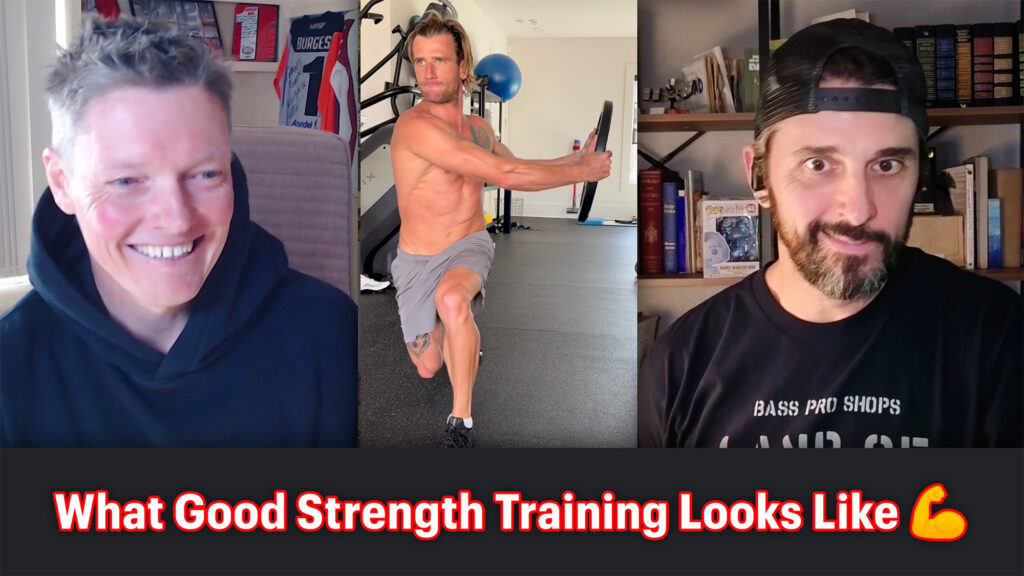
For the August episode of the Seat Time Podcast, I asked Ben Greenwood from Race Ready Offroad Coaching to come on the show. He recently posted a reaction reel to Ken Roczen’s training that got my attention. He spoke to how traditional the strength training Ken Roczen was doing was, and how all of us riders can learn from what Ken Roczen training was showing us. I knew then that a discussion with Ben needed to happen. I hope you enjoy the training, nutrition, and Australian off-road rabbit holes.
Watch/Listen to the Episode:
Ken Roczen’s Training Reel
A few weeks ago, Ben posted a reaction reel to a training video Ken Roczen had shared. What stood out to Ben was how traditional the strength training was. No BOSU balls, no bike frames welded to springs, none of the sport specific exercises that usually show up on social media. Ben told me a few of his own clients had sent him the reel too, saying it looked like Kenny was doing the same programming they were. For Ben, that mattered because riders at Roczen’s level rarely show what their training actually looks like, and what it showed was years of consistent, unglamorous work rather than anything flashy.
The Eight-Week Myth
Ben and I talked through why eight-week and twelve-week training programs fall short for most riders. If you train with a barbell three times a week for twelve weeks, that adds up to 36 sessions. Each session might only include six to ten working sets. That’s not enough repetition to properly learn a squat or a hinge pattern, let alone build the kind of durability Roczen has built over more than a decade of professional racing. Ben’s view is that strength training isn’t something you complete. It’s maintenance you keep up for as long as you want to keep riding. I’ll amend that to say you should keep it up as long as you want to have a long and happy life.
Strength training isn’t something you complete. It’s maintenance for the body.
We also compared that to how much time most riders actually spend on a dirt bike. Most of us ride once or twice a week at best. In that same stretch of time, you can get in far more reps with a barbell than laps on a track. If seat time is limited, strength training becomes the next best way to build the capacity to handle the riding you do get.
The Under-Eating Problem
Ben shared a story that mirrored something I went through myself. At 67 kilos and lean, with visible abdominal veins, he had blood work done and was told he was pre-diabetic. A qualified nutritionist recommended a keto diet and told him calories didn’t matter, only nutrient quality. His condition got worse. It turned out he was under-eating relative to how much he was training, and the carbohydrates he had cut were what his body actually needed. I went through a similar process after my psoriatic arthritis diagnosis, following nutrition advice that sounded reasonable but didn’t hold up once I applied it. Even qualified professionals can get this wrong, especially when they’re chasing the latest fad being talked about online. Ben still sees under-eating relative to training load as one of the most common mistakes among new clients.
GNCC vs Australia
Ben and his team traveled to the United States for the first time this year, and the differences in scale were immediate. A single Mid-East GNCC round drew more entries than a full national championship round in Australia. The bigger difference, though, was being allowed to walk out and watch the race from the track. In Australia, insurance requirements have kept spectators behind bunting (banner or ribbon for us Americans) for the past couple of years, meaning riders’ teams often wait 25 to 30 minutes between sightings of their rider. At a GNCC, despite the scale and the more relaxed pit rules, Ben found that spectators still respected the track, and he was able to see his rider three or four times per lap.
We also discussed who the greatest Australian export to American off-road racing has been. Shane Watts was Ben’s childhood idol, known for racing on worn-out equipment and still winning. Ben ultimately gave the edge to Josh Strang, citing his longevity, still competitive near the front of GNCC fields after close to two decades of racing in the United States.
Thank you Ben Greenwood for the Fun Conversation
Strength training works best as ongoing maintenance rather than a short program. Eating enough to match your training and riding load matters more than most people realize. And even though I’ll probably never be allowed at a GNCC again, you should keep showing up and supporting the sport.
The full conversation with Ben Greenwood of Race Ready Offroad Coaching is our for your listening pleasure. You can follow Ben on Instagram at @offroadperformancecoach.
0 Comments
Leave A Comment